
Last Updated: March 2026 | Peer Reviewed by The PCC Research Team


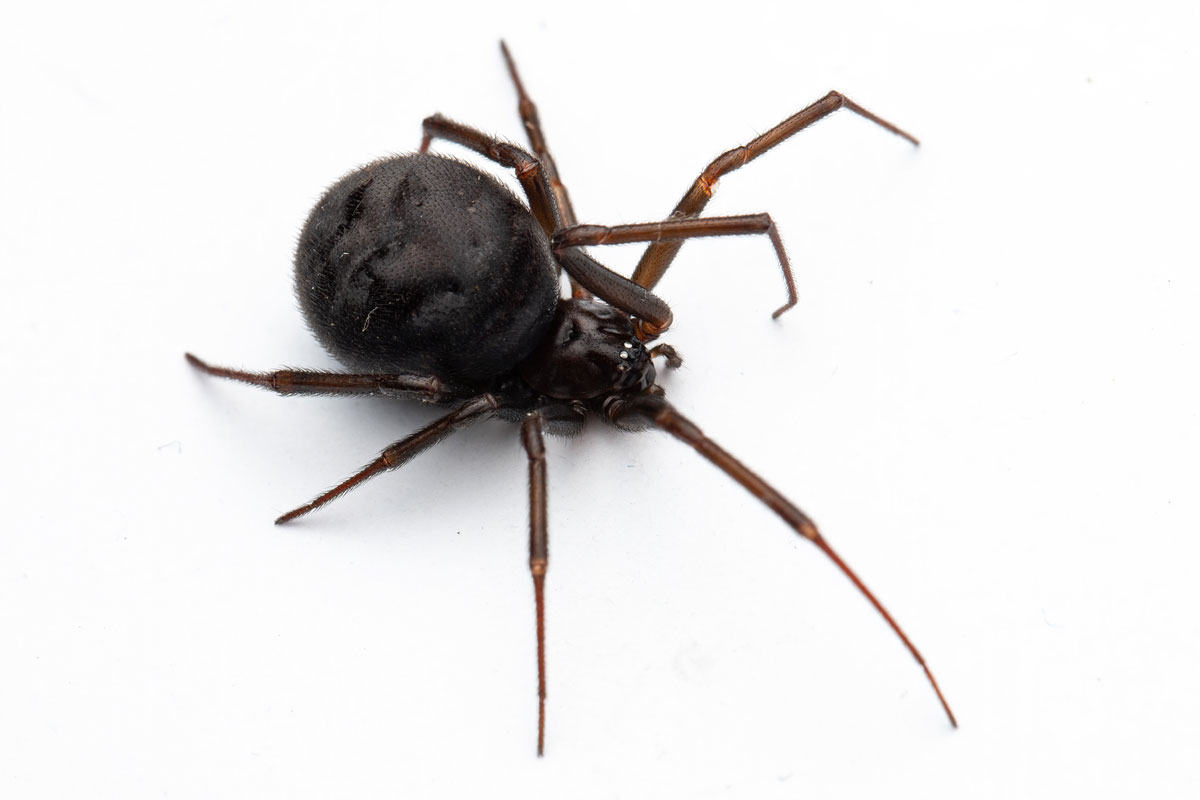


The False Black Widow Spider (Steatoda grossa) is one of the most common house spiders in California. Because of its dark, glossy, and rounded abdomen, it is frequently mistaken for the highly venomous True Black Widow (Latrodectus mactans), leading to unnecessary panic among homeowners.
Native to Europe, this cosmopolitan species has thrived in California’s urban and suburban environments. It prefers dark, sheltered, and undisturbed areas—such as garages, basements, sheds, and the undersides of patio furniture.
1. How to Identify a False Widow
Proper identification is critical. While they share a similar body shape with true widows, Steatoda grossa has distinct visual differences:
- Coloration: Dark brown, purplish-brown, or dark plum. They rarely possess the pure, glossy jet-black hue of a true widow.
- Abdomen Markings: They do not have a red hourglass on their underside. Instead, females may have pale, cream-colored, or purplish mottling/banding on the top (dorsal) side of their abdomen. Note: Older females often lose these markings and appear solid dark brown.
- Body Shape: Females have a bulbous, globular abdomen and long, spindly legs. Males are significantly smaller and thinner.
- Web Structure: They build messy, irregular, tangled “cobwebs” in dark corners, rather than the structured orb webs of garden spiders.
False Widow vs. True Black Widow
| Feature | False Widow (Steatoda) | True Black Widow (Latrodectus) |
|---|---|---|
| Belly Marking | None. Usually solid brown/black. | Distinct Bright Red Hourglass. |
| Body Color | Purplish-brown to dark brown. | Jet black and highly glossy. |
| Aggression | Very shy. Will flee or play dead. | Defensive if web or egg sac is disturbed. |
| Venom Threat | Mild (Similar to a bee sting). | High (Neurotoxic, requires medical care). |
A bite from Steatoda grossa is medically insignificant for the vast majority of humans and pets. They will only bite if provoked or trapped against the skin (e.g., hiding inside a shoe or glove).
- Symptoms: Localized redness, minor swelling, and mild to moderate pain lasting 1–12 hours (similar to a wasp sting).
- Rare Reactions: In very rare cases, sensitive individuals may experience minor nausea, lethargy, or a headache—a mild condition referred to as steatodism. Serious complications are virtually unheard of.
2. California Distribution & Habitats
The False Widow is highly adaptable and thrives across the state of California.
- Northern California (Bay Area, Sacramento): Frequently found in damp basements, wood sheds, and older window frames to escape the winter wetness.
- Central Valley (Fresno, Bakersfield): Abundant in agricultural outbuildings, barns, and detached garages to escape the intense summer heat.
- Southern California (Los Angeles, San Diego): Extremely common underneath patio furniture, pool equipment, block walls, and inside irrigated garden areas.
Primary Indoor Hiding Spots: Closets, crawl spaces, attics, underneath cabinets, and behind large appliances.
3. DIY Control & Prevention
Because they are a nuisance rather than a medical threat, aggressive chemical eradication is rarely required. Managing False Widows relies heavily on exclusion and environmental modification.
- Physical Removal: The most effective immediate solution. Use a vacuum with a hose attachment to suck up the spiders, their messy webs, and their white, papery egg sacs. Empty the canister immediately outdoors.
- Reduce Clutter: False widows love undisturbed hiding spots. Organize garages by keeping boxes off the floor (use plastic bins instead of cardboard).
- Eliminate the Food Source: Spiders build webs where insects are plentiful. Switch exterior white light bulbs to yellow “bug lights” to stop attracting the flies and moths that spiders eat.
- Exclusion: Apply weather stripping to doors, caulk cracks in the foundation, and ensure window screens are tight-fitting.
4. Recommended Control Products
For persistent spider issues in garages or storage spaces, the PCC Research Team recommends exploring professional pest control products, specifically combining sticky traps with targeted barrier treatments.
5. When to Call a Professional Exterminator
While DIY methods work for minor issues, you should contact a licensed California pest control professional if you are finding multiple large spiders indoors and cannot definitively identify whether they are False Widows or True Black Widows, or if you have a severe infestation in a hard-to-reach area like a deep crawlspace.
6. Frequently Asked Questions
Q: What is the difference between a False Widow and a Black Widow?
A: The most obvious difference is the abdomen. A true Black Widow has a distinct, bright red hourglass shape on its belly. The False Widow (Steatoda grossa) has no red markings at all, and is usually a dark, purplish-brown rather than a deep, glossy black.
Q: Are False Widow spiders dangerous to dogs or cats?
A: Generally, no. A bite from a False Widow on a dog or cat will usually only cause mild, localized swelling and discomfort, similar to a bee sting. It does not carry the severe neurotoxins of a true black widow.
Q: Why do I have so many False Widows in my garage?
A: Garages provide the perfect habitat: they are dark, dry, undisturbed, and usually have gaps under the door that allow insects (spider food) to wander inside. They often build their webs near the ground or around stored clutter.